
The Trap of Changing Marital Status During A Pending Canadian Study Permit Application
Managing a marital status study permit profile change during processing requires absolute transparency, precise timing, and a deep understanding of how Immigration, Refugees and Citizenship Canada (IRCC) evaluates files. For many international student applicants, life does not hit the pause button while waiting for a visa decision. Major milestones—such as getting married or entering a common-law relationship—frequently occur during the processing window.
While these milestones are celebratory in personal life, failing to manage them correctly within a pending study permit application can lead to a catastrophic administrative trap. Many applicants mistakenly believe that because their relationship is legal, it does not affect their application until they arrive in Canada. In reality, a change in marital status fundamentally alters the legal parameters of a visa file. Failing to report this change promptly is one of the most common reasons for unexpected visa refusals and long-term immigration bans.
1. The Omission Trap (Believing Your Pending Application is Frozen)
The foundational principle under Section 16 of Canada’s Immigration and Refugee Protection Act (IRPA) is that an applicant must answer truthfully all questions put to them for the purpose of their examination. This obligation is not a one-time box to check when hitting the “submit” button on the IRCC portal; it is a continuous legal duty.
An application is legally considered “pending” from the moment it is submitted until an immigration officer makes a final determination and issues a visa decision. Throughout this entire processing window, you are required by law to inform IRCC of any material change in your personal circumstances.
Why Marital Status is “Material”
Marital status is considered highly material under Canadian immigration law because it alters how an officer assesses:
- Your financial capacity: The minimum funds required to support a single student differ sharply from the funds required to support a couple.
- Your ties to your home country: Marrying a fellow citizen or a resident of another country modifies your socio-economic baseline.
- Your dual intent: IRCC evaluates whether your temporary stay remains genuine, even if you ultimately hope to immigrate permanently under programs like Express Entry.
If you marry or enter into a common-law relationship while your study permit application is in queue, your file is no longer legally accurate. Proceeding without updating IRCC constitutes an immediate breach of your ongoing obligation to provide complete and accurate data.
2. The Airport Surprise Trap (Waiting to Disclose Status at the Border)
A frequent and highly dangerous piece of advice circulated in unauthorized forums and by predatory agencies is the idea of the “Landing Update.” Applicants are often told: “Don’t complicate your current application. Wait until your study permit is approved, fly to Canada, and simply tell the border officer at the airport, or sponsor your spouse after you arrive.”
This advice is completely wrong and sets a dangerous trap.
The Regulatory Disconnect
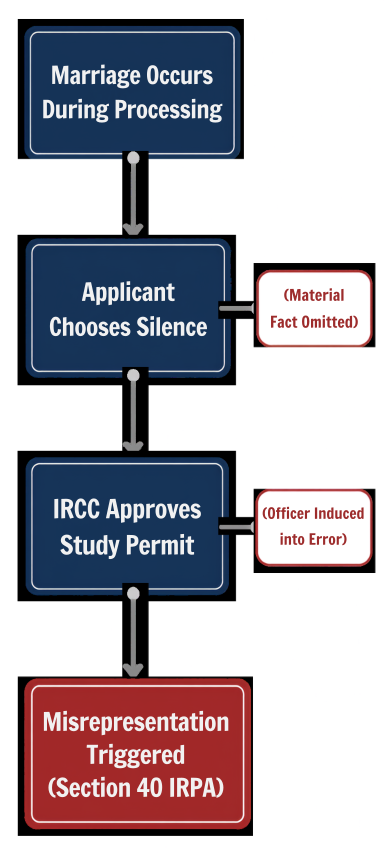
When a visa officer reviews a study permit application, they assess eligibility based on a single individual. If you marry during processing but remain silent, the visa is ultimately issued under false pretenses—even if you did not intend to deceive.
When you land at a Canadian Port of Entry (POE), the Canada Border Services Agency (CBSA) officer has the legal authority to re-examine your admissibility. If you declare your new spouse at the border, or if the officer discovers the marriage through passport stamps or data sharing, you have a major structural disconnect. The visa in your passport was approved for a single applicant, but you are presenting yourself at the border as a married person.
The border officer can immediately find that your circumstances changed materially before issuance, rendering your underlying visa invalid. This can result in you being turned away at the airport, having your study permit cancelled on the spot, and being sent back to your home country.
3. The Section 40 Landmine (Unintentional Misrepresentation and Bans)
The most severe consequence of failing to disclose a change in marital status is a formal allegation of misrepresentation under Section 40 of the IRPA.
In Canadian immigration law, misrepresentation does not require a deliberate intent to lie or forge documents. It includes any omission, silence, or failure to disclose a material fact that could induce an error in the administration of the Act.
The Long-Term Consequences of a Section 40 Finding
If IRCC discovers that you were married while your application was pending but failed to disclose it, the penalties are swift and severe:
- Immediate Application Refusal: The current study permit application is denied, regardless of your academic qualifications or financial standing.
- A Five-Year Bar: You are issued a baseline five-year ban from entering Canada or submitting any type of temporary or permanent Canadian immigration application.
- A Permanent Flag: A permanent mark of fraud is added to your global immigration record, which is shared with international security networks like the Five Eyes alliance (including the US, UK, Australia, and New Zealand), making future global travel difficult.
4. The Domino Effect on Spousal Open Work Permits (SOWP)
Many international students keep their marriage quiet during processing because they plan to have their spouse join them later using a Spousal Open Work Permit (SOWP). However, keeping the marriage quiet creates a legal paradox that destroys any future SOWP strategy.
The Exclusion Trap
To successfully sponsor or support a spouse’s temporary entry into Canada, that spouse must be recognized by IRCC. If you land in Canada as a student on a permit that was approved while you were single, but your official marriage certificate shows a wedding date prior to your visa approval, IRCC’s system will flag the chronological overlap during the subsequent SOWP processing.
The work permit application for your spouse will reveal that you failed to disclose them when your own application was evaluated. Consequently, the spouse’s work permit application will be summarily refused due to your non-disclosure. Even worse, it frequently triggers a retroactive investigation into your own study permit, putting you at risk of deportation while you are in the middle of your academic semester.
5. The Chaos Trap (Failing to Use a Structured File Update Blueprint)
The ImmiScape File Update Blueprint
- Step 1: Secure Certified Translation Seals: Do not upload a foreign marriage
- certificate raw. Obtain a spotless digital copy alongside a certified translation bearing a professional stamp and an accuracy affidavit.
- Step 2: Recalculate Your Financial Tracking Lines: Update your proof-of-funds portfolio to match Canada’s multi-person cost-of-living requirements. For applications submitted starting September 1, 2026, the baseline cost-of-living requirement for a family of two (you + your wife) is $29,192 CAD for the first year. Upload fresh, stable 4-to-6-month bank statements to prove your household can support a couple.
- Step 3: Re-Validate Your IMM 5707 Family Profile: Download, edit, and re-sign your core family information and any other statutory forms. Ensure your new spouse’s biographical details are fully declared so they are recognized by IRCC from day one.
- Step 4. Submit a Priority Webform Broadcast: Draft an explicit cover letter stating your application number, UCI, and full passport details. State your marriage date clearly and request to update your material personal history.
Summary Checklist for Applicants
| Action Item | Verification Criteria |
| Monitor Filing Dates | Check that any wedding date falls strictly outside the active processing window; if it falls inside, trigger a webform update immediately. |
| Audit Financial Lines | Verify that bank balances match or exceed the updated cost-of-living allocations required for a multi-person household file. |
| Verify Translation Stamp | Ensure all foreign marriage certificates bear a certified professional translator’s stamp and an accompanying accuracy affidavit. |
| Confirm Form Alignment | Double-check that all biographical details on updated statutory forms match your spouse’s valid passport exactly. |
Conclusion
A change in marital status does not mean your dream of studying in Canada is over, but it does require meticulous administrative care. Transparency is the only pathway to a successful visa outcome. By declaring your marriage openly, updating your financial profile, and respecting IRCC’s strict disclosure rules, you protect yourself against life-altering penalties and keep your immigration journey on track.
If you are applying for a study permit or currently navigating a change in personal circumstances while your application is in the queue, Immiscape Immigration Solutions Solutions can provide specific guidance to ensure your next step aligns perfectly with Canadian immigration law.