
For over a decade, navigating the financial requirements for a Canadian immigration journey felt predictable. Students and consultants knew the magic numbers, and there was a widespread, comfortable assumption that once a student was physically inside Canada, the heaviest financial scrutiny was behind them. Many believed that obtaining a study permit extension was merely a matter of proving good academic standing and showing enrollment for upcoming semesters.
However, the regulatory landscape has shifted underneath the feet of international students. Today, students already inside Canada are increasingly shocked to find international student advisors and Immigration, Refugees, and Citizenship Canada (IRCC) officers demanding proof of approximately $22,000 in unencumbered liquidity. Relying on old advice or "discretionary institutional practices" can lead directly to a sudden application refusal.
If you are currently studying in Canada with remaining semesters left in your program, mastering the rules is crucial. This comprehensive guide breaks down the massive regulatory overhauls shaping the cost-of-living standard, demystifies the differences in how in-Canada finances are evaluated, and provides a precise formula to secure your study permit extension flawlessly.
Understanding the nuances of your financial situation is essential for a smooth study permit extension process.
1. The Evolution of the Cost-of-Living Financial Threshold
To understand why an advisor or an officer is suddenly demanding a $22,000 baseline, we must look back at how Canada’s international student program historically managed financial thresholds.
The Stagnant $10,000 Era
For two decades, Canada's cost-of-living requirement for a single international student was locked at a baseline of $10,000. This number was set in the early 2000s and remained completely unchanged for years. While the actual cost of rent, groceries, healthcare, and transit in Canadian cities skyrocketed, the immigration requirement stayed artificially low.
This widening gap created a severe systemic issue. Students arrived in Canada believing $10,000 could sustain them for a year, only to face immediate underemployment, predatory housing situations, and an over-reliance on food banks. The policy no longer reflected economic reality.
The Great Regulatory Overhaul
Recognizing that the old system was driving student destitution, the Canadian government enacted rapid overhauls to tie financial sufficiency directly to real-world inflation and economic metrics. Starting on January 1, 2024, changes altered the landscape, more than doubling the cost-of-living requirement to $20,635 for a single applicant. Funds requirements were further increased to $22,895 on September 1, 2025.
Shifting into the Modern Standard
By tying the threshold to annual economic updates of Statistics Canada’s Low-Income Cut-Off, the required financial baseline will now be adjusted upward to match inflation each year on September 1.
Effective September 1, 2026, the updated baseline for a single international student studying outside of Quebec has been set to $23,448. This reflects an incremental adjustment from the previous year's threshold of $22,895. If you are studying inside the province of Quebec, provincial guidelines require you to satisfy separate thresholds, which climbed to $24,617.
Ensuring you have all necessary documentation for your study permit extension is crucial for success.
When academic advisors request around $23,448, they are not acting out of institutional preference; they are strictly enforcing modern, index-linked legal frameworks. To successfully obtain a study permit extension, your financial presentation must mirror these updated figures.
2. In-Canada Extensions vs. Initial Outside-Canada Applications: Debunking the Myth
One of the most persistent and damaging pieces of misinformation floating through student communities is the idea that “once you are inside Canada, the government doesn't care about your bank accounts anymore.”
When applying for a study permit extension, ensure you highlight your financial stability clearly.
Historically, some institutions may have been lenient, prioritizing academic records over thorough financial re-verification. But in the current immigration landscape, this assumption is an entry ticket to a visa refusal when you apply.
Why Scrutiny Escalates
When you apply for your initial visa from your home country, you prove your potential to pay via localized assets or a fixed Guaranteed Investment Certificate (GIC). When you apply for a study permit extension from inside Canada, a visa officer has a clear, documented history of your actual financial behavior.
Your study permit extension application should reflect your financial competence and preparedness.
During a review, the officer evaluates financial continuity and sustainability. They check to ensure you are not under severe financial distress, working illegally beyond regulated hourly limits to survive, or exhausting local welfare infrastructure.
The Problem with Discretionary Overconfidence
Students frequently run into issues when their upcoming semester timelines require an application, but they lack liquid balances. If you submit an application showcasing high grades but low liquidity, the visa officer will look past your GPA. The law requires you to prove you can continue your journey without relying on social safety nets or unauthorized work. Every successful application hinges on this liquid proof.
3. The Math Behind Remaining Semesters: Your Study Permit Extension Formula
Do not guess what amount of money needs to be in your account. You can accurately map out your required proof of funds by using IRCC’s exact evaluation formula.
An officer calculates your financial needs based on three distinct pillars:
Total Required Funds = Tuition Fees (Remaining Semesters) + Indexed Living Expenses + Return Transportation Costs
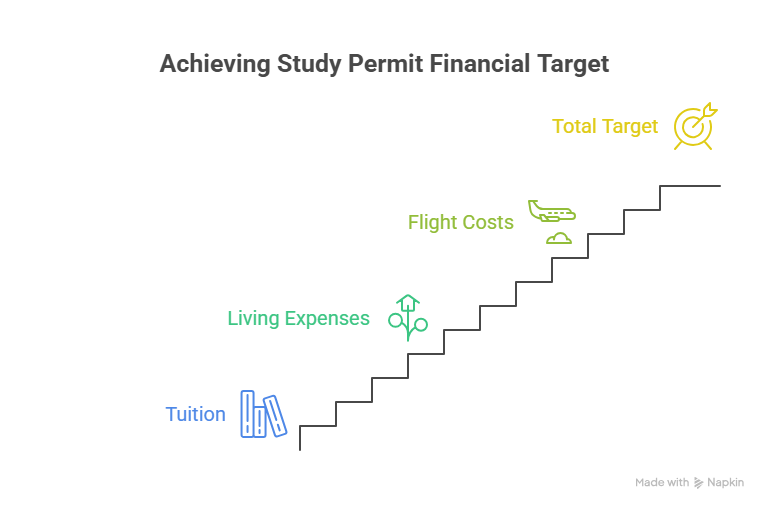
To determine your personal target number, execute this calculation manually before submitting your file:
- Step A: Calculate Outstanding Tuition: Look at your upcoming enrollment schedule or institutional invoice. Add the exact tuition cost of your remaining semesters for the year. For example, if you have 2 semesters remaining for your study permit extension period, and it costs $15,000, write that down.
- Step B: Add Indexed Living Expenses: Add exactly $23,448 (pro-rated if your remaining program is under a year) to ensure your study permit extension is approved.
- Step C: Factor in Return Transportation: Add an estimated buffer for a return flight to your home country to complete your study permit extension budget.
Total Target Amount Example:
$15,000 (Tuition) + $23,448 (Living) + $1,500 (Flight) = $39,948 CAD$
Note: If you have family members accompanying you, your base living expense tier scales significantly higher (for instance, escalating to $29,192 for two people, and $35,888 for three).
Understanding the process for a study permit extension can help mitigate potential challenges.
Understanding the Process for a Successful Study Permit Extension
4. Acceptable Financial Documentation Blueprint for Your Study Permit Extension
Use this strategic blueprint to ensure your evidence stands up to rigorous scrutiny:
Use this strategic blueprint to ensure your study permit extension evidence stands up to rigorous scrutiny:
Key Considerations for Your Study Permit Extension Application
Strong financial documentation is vital for a successful study permit extension application.
Canadian Bank Statements (The 4-Month Rule)
Provide comprehensive, official bank statements covering the last four consecutive months. Officers check for consistent historical balances. A sudden, unexplained lump-sum deposit of $20,000 right before filing will flag suspicion of a "borrowed" or temporary deposit. If a large deposit exists, it must be accompanied by clean, traceable source documentation to safeguard your approval.
Proof of Direct Payments
A complete financial overview can greatly enhance your extension chances.
Proof of Direct Payments
Binding Sponsor & Parental Declarations
If your parents or an external sponsor continue to finance your journey, a standard letter saying "I will help" is no longer sufficient. You must provide a legally binding, notarized affidavit of sponsorship. This must be backed up by your sponsor’s localized financial realities: their own past four months of bank statements, active employment letters, business registration certificates, or national tax returns. You must clearly demonstrate that the sponsor's regular income matches their financial promise.
Prepare a comprehensive strategy to ensure your application is successful.
Educational Loans and Scholarships
Educational Loans and Scholarships
5. Navigating Your Next Steps for a Study Permit Extension
Securing a study permit extension is about creating a clear, evidence-based narrative. By taking control of your financial calculations early, you can completely avoid the stress of an unexpected rejection and ensure your success.
Ready to Secure Your Future in Canada?
Don’t leave your study permit extension to chance or rely on outdated advice. Navigating the new $23,448 financial threshold requires precision, and a single documentation mistake can disrupt your entire academic journey. Contact our licensed immigration specialists today for a personalized financial file review, and let us help you submit a flawless application.